
Dr. Hakki Izmirli · Plastic Surgeon in Istanbul
Composite Butt Augmentation
Buttock implants + fat transfer in a single surgical plan. The implant provides the foundation and central projection, while carefully placed fat refines the contours around the buttocks, hips, waist and thighs.
Free Consultation on WhatsApp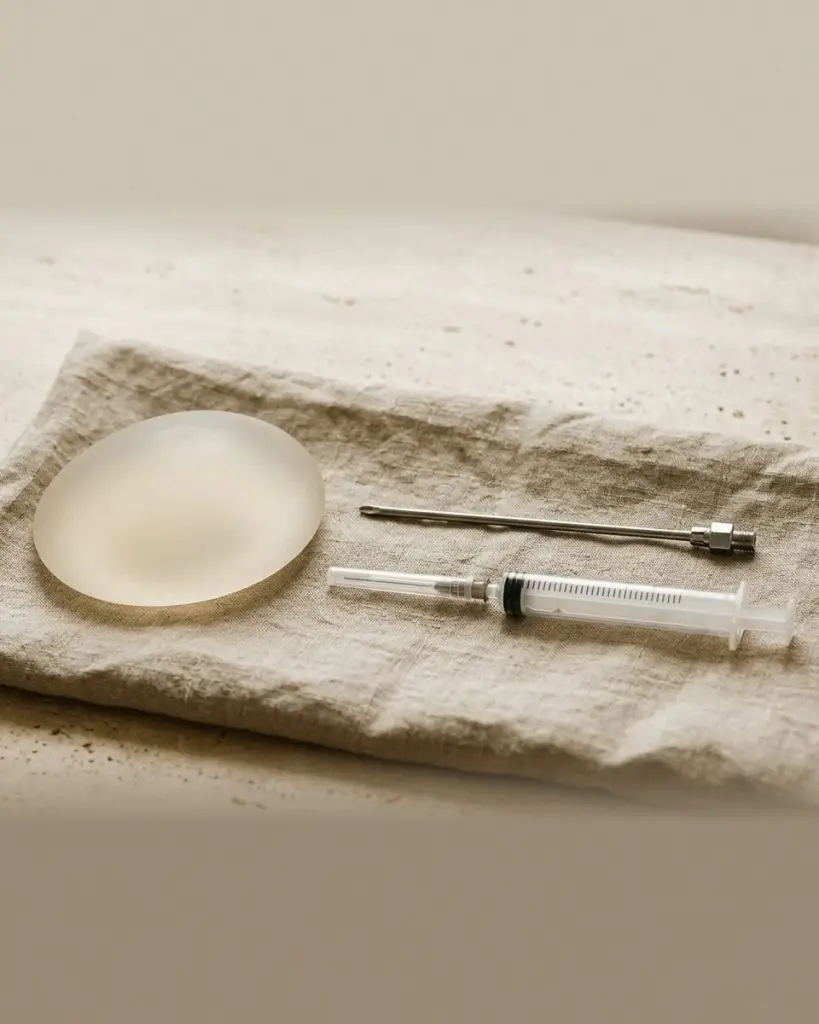
The procedure
What is composite butt augmentation?
For patients seeking fuller, rounder and more projected buttocks, fat transfer alone is not always enough — particularly for slim patients with limited donor fat, or those who want more significant and predictable projection. Sometimes referred to as a “Supercharged BBL” or BBL with implants, composite augmentation combines different techniques to address different components of buttock shape:
Buttock implants
Increase volume and projection, particularly in the central buttock.
Liposuction
Contours the abdomen, waist, flanks or lower back, improving the waist-to-hip transition so the buttocks appear more defined.
Fat transfer
Used selectively around the buttocks and hips, where appropriate, to refine contours and soften transitions.
The objective is not simply to make the buttocks larger, but to improve the overall proportions of the lower body.
Two techniques, one plan
Why combine implants with fat transfer?
A traditional BBL relies on the patient’s own fat. This works well when there is sufficient donor fat — but some patients simply do not have enough to create the projection they want. Buttock implants offer an alternative, because their volume does not depend on fat reserves. However, an implant creates volume only where it is positioned; it cannot independently correct every contour irregularity or add volume in every area of the hip and buttock.
The implant
Creates the main projection and provides a defined volume that does not depend on fat survival.
Fat grafting
Refines the contour around the implant and creates smoother transitions — the two techniques play different but complementary roles.
Low body fat
Composite augmentation for slim patients
A common misconception is that thin patients cannot have buttock augmentation because they do not have enough fat for a BBL. Limited donor fat may make a large-volume BBL unsuitable, but it does not make buttock enhancement impossible. In selected patients, even a small amount of fat can be strategically useful when combined with an implant: the implant provides most of the projection, and the available fat is reserved for the areas where it has the greatest contouring benefit.
Possible donor areas
· Abdomen
· Waist
· Flanks
· Lower back
· Inner thighs
· Outer thighs
Assessed individually
Available donor areas vary considerably between patients. This makes composite augmentation particularly relevant for slim patients who want greater projection but are not ideal candidates for a conventional BBL alone.
On the day
How is it performed?
The operation is planned according to your anatomy, existing buttock shape, skin quality, donor fat and the degree of projection you want. It generally involves three components:
1 · Liposuction & contouring
Fat is harvested and the surrounding contour improved — especially the abdomen, waist, flanks and lower back, to define the waist. Slim patients may need only limited harvesting; the amount is individualised.
2 · Implant placement
Size and shape are chosen according to buttock dimensions, muscle anatomy, soft-tissue thickness, existing projection, pelvic proportions, skin quality and the desired result.
3 · Fat transfer & refinement
Once the main projection is created, available fat is placed selectively to refine the surrounding contour. Location and amount are determined by anatomy and surgical safety.
Choosing the largest possible implant is not necessarily the best strategy. Excessively large implants may increase tension on the tissues and may not produce a proportionate, natural-looking result. The goal is meaningful projection in balance with your overall body proportions.
Comparing options
Composite vs BBL vs implants alone
Compared with a BBL
With a BBL, enlargement depends on how much suitable fat can be harvested — and not all transferred fat survives permanently. With composite augmentation, an implant provides a substantial part of the volume. It can be an option if you:
· have insufficient fat for your desired BBL result
· want stronger central projection
· have had liposuction before and have limited donor areas
· want more augmentation than fat alone can predictably provide
Compared with implants alone
Implants can provide significant projection even with very little body fat, but they mainly influence the area in which they are placed. Adding liposuction and selective fat transfer allows the operation to address the silhouette as a whole — the waist, hips, lower back, buttock width and projection are evaluated together, not just the implant size.
Hip contour
Can hip dips be treated at the same time?
In selected patients, fat grafting may be considered for contour irregularities around the lateral hip. This depends heavily on the amount of donor fat available and your underlying anatomy. For a very slim patient, available fat may be limited and must be used strategically rather than attempting excessive-volume grafting. During consultation we determine how much fat can realistically be harvested and which areas should have priority.
Results
What results can it achieve?
Possible improvements
· Increased buttock projection and volume
· Improved waist-to-buttock proportions
· Smoother transitions around the buttocks
· Improved contour around selected hip areas
· Greater definition of the lower back and waist
Realistic expectations
Results vary substantially. A patient with narrow hips, limited fat and tight tissues will not have the same possibilities as someone with wider pelvic proportions and more donor fat. Planning focuses on what can realistically be achieved with your anatomy — not on reproducing another person’s result.
After surgery
Recovery & scars
Early recovery
Swelling, tightness and discomfort are expected at first. You will receive specific instructions on sitting, sleeping, walking and activity, and a compression garment for the liposuction areas.
Activity
Light walking is encouraged to support circulation. Strenuous exercise and heavy lower-body activity are avoided until adequate healing has occurred.
Scars
The implant incision is placed in the natural crease between the buttocks, so the scar is less conspicuous. Like every scar, it matures over several months.
Recovery protocols vary with the extent of liposuction, implant placement and fat transfer, and with your individual healing.
Safety
Risks and safety
Composite butt augmentation is a major surgical procedure and should be approached accordingly. Potential complications include bleeding, infection, seroma, wound-healing problems, asymmetry, scarring, changes in sensation, implant displacement, implant-related complications, fat resorption and the possible need for revision surgery.
Fat transfer to the gluteal region requires strict adherence to modern safety principles — the surgical technique and the anatomical plane used for fat injection are important. A detailed medical history, physical examination and appropriate pre-operative tests are essential before surgery.
Is it right for you?
Who may be a good candidate?
It may suit you if you
· Want greater buttock volume or projection
· Do not have enough donor fat for the result you want with a BBL alone
· Want both projection and surrounding contour refinement
· Are medically suitable for elective surgery
· Have realistic expectations about your anatomy and outcome
· Understand the recovery requirements of gluteal implant surgery
An individual assessment
Suitability cannot be judged from photographs of another patient’s result or from implant size alone. There is no single technique right for everyone: fat transfer alone may suit patients with enough donor fat and moderate goals; implants may suit very slim patients seeking substantial projection; others benefit most from combining both.
International patients
Composite butt augmentation in Istanbul
Istanbul has become an international destination for body contouring and plastic surgery. For international patients, the consultation can begin before you travel: photographs and medical information are reviewed to give a preliminary assessment of your buttock shape and projection, potential implant requirements, available donor fat, areas that may benefit from liposuction, and whether a composite procedure may be preferable to a BBL or implants alone. The final surgical plan is confirmed after an in-person examination.
FAQ
Frequently asked questions
Is it the same as a BBL with implants?
The terms are sometimes used interchangeably. Composite augmentation generally means combining gluteal implants with fat grafting and, where appropriate, liposuction-based body contouring.
Is it suitable for skinny patients?
It can be particularly useful for slim patients who do not have enough donor fat for their desired projection with a BBL alone. The implant provides the primary volume, while smaller amounts of fat are used for contour refinement.
How much fat is needed?
There is no fixed amount. Because the implant provides the primary projection, composite augmentation does not require as much donor fat as a fat-transfer-only BBL.
Where can the fat be taken from?
Common donor areas include the abdomen, waist, flanks, back and thighs. Available areas are assessed individually.
Can I choose my implant size?
Your preferences matter, but implant selection also depends on anatomical measurements, muscle dimensions, tissue thickness and safety. The final implant should be proportionate to your anatomy.
Is the result permanent?
Implants provide long-term structural volume but, like all implants, may need monitoring or further surgery during your lifetime. Fat that establishes a blood supply can remain long-term, while some absorption is expected during healing.
Is it more natural than implants alone?
In appropriate patients, fat grafting can refine the areas around the implant and create smoother contour transitions. The achievable result depends on anatomy, donor fat and the surgical plan.
Start with an online assessment
Send photographs of the front, back and both sides, together with your height, weight, previous operations, medical conditions, regular medications and smoking history. The aim is not simply to choose between a BBL and an implant, but to find the combination of projection, volume and body contouring that best matches your anatomy and goals.
Message us on WhatsApp